 Search
 EN
 English
 Deutsch
 Français
 Español
 italiano
 cn
 jp
 kr
A green tint on glasses trades a little brightness for noticeably cleaner contrast. The tint absorbs part of the visible spectrum, most strongly in the red and blue bands, so greens and yellows separate more sharply, glare flattens out, and long bright hours outdoors feel easier on the eyes. It is a comfort and contrast tool, not a treatment for eye disease, and it is not the same thing as the green sheen you see reflected off an anti-reflective coating.
In practice, a green tint is defined by visible light transmission (VLT): the share of daylight that reaches the eye. A typical green sunglass lens sits between 12% and 18% VLT, while a light fashion tint can pass 60% or more. Everything the tint does, from glare control to colour shift to whether it is safe behind a windscreen, follows from that number and from how evenly the colour is laid down across the lens.
The short version, before the detail:
- Green deepens contrast; grey stays neutral; brown warms the scene.
- Strongest use cases are bright daylight, turf and court sports, water, snow and daytime driving.
- Weak use cases are night driving, dusk, indoor work and colour-critical inspection.
- A green reflex on a clear lens is a coating, not a tint, and barely changes colour perception.
Content
- 1 Green Tint or Green Coating? They Are Not the Same Product
- 2 What a Green Tint Actually Does to Light
- 3 Who Green Tint Suits, and Where It Falls Short
- 4 Picking a Shade: Grey-Green, True Green, Gradient or Mirror
- 5 Specification Checklist for Private Label and OEM Orders
- 6 Care, Fading and the Complaints Buyers Actually Report
- 7 Frequently Asked Questions
Green Tint or Green Coating? They Are Not the Same Product
Four different things on a lens can look green, and only two of them genuinely change what you see. Buyers who mix them up end up comparing a cosmetic sheen against a functional tint and wondering why the samples behave so differently.
| What you see | What causes it | Effect on vision | Where it belongs |
|---|---|---|---|
| Even green cast across the whole lens | Dye in the lens mass, or a dyed hard coat | Lowers VLT, mutes reds, lifts contrast | Sunglasses, sport and driving lenses |
| Green or emerald sheen at an angle | Residual colour of an anti-reflective coating | Almost no colour shift; reduces surface reflections | Clear prescription lenses |
| Mirror-green front surface | Vacuum-deposited mirror layer | Cuts reflected light and hides the eye | Fashion and sport sunglasses |
| Faint green edge on a thick lens | Light scatter at the lens edge | None in normal wear | High-index prescription lenses |
The practical consequence: if a customer complains that their clear glasses "have a green tint", they are almost certainly seeing a coating reflex. If they complain that the world looks greener and reds look muddy, they are wearing an actual tint.
What a Green Tint Actually Does to Light
Green keeps the band the eye is most sensitive to and trims the rest, which is why it preserves apparent brightness better than most other tints at the same VLT. The photopic eye peaks around 555 nm, right in the green-yellow region, so a green lens delivers more perceived light per unit of darkening than a grey or brown lens of identical transmission.
There is a second, less obvious effect. Green wavelengths focus close to the retina's best focus point, so edges and text can appear slightly crisper through a light green tint. That is one reason green-tinted lenses have a long history in precision work and shooting sports, and why they are often described as "sharpening" a scene even when the transmission is high.
| Lighting situation | Suggested VLT | Lens category | What it feels like |
|---|---|---|---|
| Full sun, water, snow, high altitude | 8% to 18% | Category 3 | Deep glare cut, strong contrast, reds noticeably muted |
| Bright but changeable daylight | 18% to 43% | Category 2 | Comfortable all day, colours still readable |
| Overcast, early morning, late afternoon | 43% to 80% | Category 1 | Mild contrast lift, little glare protection |
| Night driving, indoor use | Above 80% | Category 0 | Not recommended for a tinted lens |
Who Green Tint Suits, and Where It Falls Short
Green pays off in bright, colour-rich outdoor scenes and costs you in low light and colour-critical tasks. That single rule covers most of the selection decisions buyers face.
Where green earns its place
- Golf and turf sports: the tint exaggerates the difference between fairway, fringe and green, which helps with reading slope and distance.
- Tennis and other ball sports: a yellow ball against a green or blue court separates more cleanly.
- Cycling and trail running: contrast on gravel, roots and shadows improves at speed.
- Fishing and sailing: glare off water is reduced while the horizon stays readable.
- Daytime driving: dashboard reflections and road glare soften without the scene turning brown.
- Light sensitivity: wearers with photophobia or migraine triggers often tolerate a mid-density green tint well.
Where green works against you
- Night driving: even a light tint reduces contrast exactly when the eye needs it most.
- Dusk and heavy overcast: a Category 3 green lens makes shadows unreadable.
- Colour-critical work: electricians, printers, paint matchers and lab technicians should avoid it, because reds and skin tones shift.
- Aviation and marine signal work: colour identification of lights and markers can be compromised.
For everyday sun wear rather than sport, a mid-density green over a neutral base is the safer specification, and it sits comfortably alongside the rest of a sunglasses collection.
 Vintage Acetate Polarized Sunglasses Model 8860Mid-density green tint over a neutral base suits everyday wear, while the acetate frame and TAC polarized lenses add UV and glare protection.View Product →
Picking a Shade: Grey-Green, True Green, Gradient or Mirror
For all-day wear, a grey-green tint between 15% and 25% VLT is the safest default; reserve saturated green for sport and short sessions. The base colour underneath the green decides how natural the world still looks.
| Style | Appearance | Strength | Watch out for |
|---|---|---|---|
| Grey-green | Neutral with a faint green note | Natural colour balance for general use | Can look flat in low light |
| True green | Clearly green | Maximum contrast on grass and foliage | Distorts reds and skin tones |
| Green mirror | Reflective front surface | Extra glare rejection plus styling | Scratches and fingerprints show badly |
| Green gradient | Dark at the top, clear at the bottom | Distance shading while the dashboard stays visible | Uneven protection if the wearer looks down |
| Light green fashion tint | Pale, 60% to 80% VLT | Indoor-to-street styling | Almost no sun protection; avoid claiming UV defence without a test report |
If the project involves a metal frame and a lightweight build, tinted lens options for that construction are worth reviewing together with the frame choice.
 Pure Titanium TAC Polarized Sunglasses Model 9093Titanium-frame sunglasses with TAC polarized lenses pair with tinted lens options; green lens transmission consistency and coating adhesion should be specified in writing.View Product →
Specification Checklist for Private Label and OEM Orders
Three things decide whether a green lens ships well: transmission consistency, tint uniformity, and coating adhesion. Everything else is secondary, and all three should appear in writing on the purchase order.
- VLT target and tolerance: state the nominal value and accept no more than plus or minus 3 percentage points for mainstream runs, plus or minus 2 for premium.
- Batch-to-batch colour: request a colour difference limit, typically a Delta E of 1.5 or lower under daylight illumination, so repeat orders match.
- Tint uniformity: check edge-to-centre density on a light box; swirls and mottling are rejects, not cosmetic quirks.
- Polarised film alignment: axis within 3 degrees, polarisation efficiency at 99% or above, verified on a sample from each lot.
- UV claim: UV400 means under 1% transmission below 400 nm, and it should be backed by a test report rather than a label.
- Coating adhesion: tape pull plus sweat and salt-fog exposure, especially for sport and marine programs.
- Substrate match: CR-39, polycarbonate, nylon and TAC each take dye differently, so the same recipe will not give the same VLT across materials.
- Frame and thickness interaction: a thick lens edge reads darker than the centre, which matters on high-power prescription work.
Prescription programs need one extra step: confirm whether the tint is applied before or after the prescription surfacing, because a post-surfacing dye bath can shift the axis mark and the edge density.
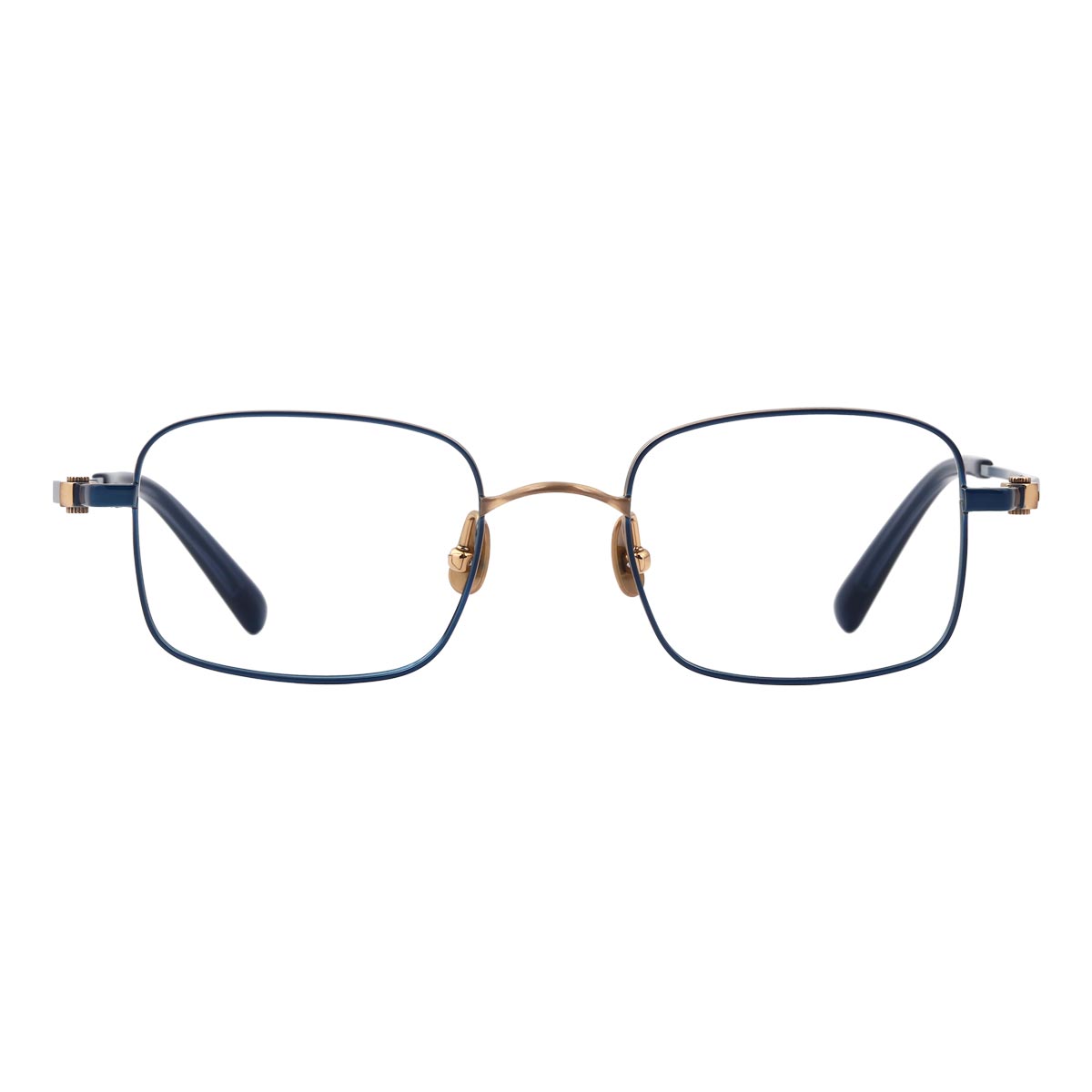 Lightweight Pure Titanium Optical Frame AD9012Lightweight titanium optical frame supports prescription and blue-light lenses; confirm tint timing during surfacing, as post-surfacing dye can affect axis marks and edge density.View Product →
Care, Fading and the Complaints Buyers Actually Report
Most green-tint complaints trace back to heat or coating failure rather than to the colour itself. A tinted lens left on a car dashboard in summer can drift in density, and a mirror coating cleaned with solvent will haze long before the tint fades.
- Clean with water and a neutral soap; alcohol-based cleaners attack both dye layers and anti-reflective stacks.
- Store away from heat; the glovebox is the worst place for any tinted lens.
- Sunscreen and salt water leave films that look like tint damage, so test cleaning before rejecting a lot.
- Mirror and gradient coatings scratch visibly; specify a protective hard coat when the product is aimed at sport.
- Dyed lenses can fade over years of UV exposure; mass-tinted material holds its density longer.
Reading a lens on a light box before and after a cleaning cycle is a quick way to separate a manufacturing fault from wear and tear.
Frequently Asked Questions
Does a green tint block blue light?
Partly. Green absorbs more short-wavelength light than grey, but a green sunglass lens is a glare tool, not a screen filter. For screen work, a dedicated low-density blue-filtering lens is the more appropriate specification.
Is green tint good for computer use?
Generally no. Office lighting is already modest, and any tint below roughly 80% VLT reduces contrast on a monitor. A clear lens with an anti-reflective coating is the better choice indoors.
Can a green tint be added to prescription lenses?
Yes. It can be dyed into the lens or applied as a tinted coat, and it can be combined with a prescription, a polarised film or a mirror layer. Once tinted, the lens cannot be returned to clear, so the VLT must be agreed before production.
Is green tint bad for colour vision?
It shifts colour rather than damaging it. Reds and skin tones lose saturation, which is acceptable for leisure wear and unsuitable for inspection, printing or any task where colour is a decision input.
How does green compare with grey and brown?
Grey is the most neutral and the safest for colour accuracy. Brown warms the scene and improves contrast in flat light. Green sits between them, with the strongest contrast gain in foliage and the largest shift in reds.
Does green tint help with night driving?
No. Any tint reduces light reaching the eye after dark, and green is no exception. Anti-reflective coatings and clean, unscratched lenses are the useful measures for night vision.
A green tint is a low-risk, high-payoff choice when it matches the light the wearer is actually in: a grey-green base around 15% to 25% VLT for general sun, a denser saturated green for turf and water, and no tint at all after dark. Specify the transmission number, the tolerance and the uniformity standard before the first sample is cut, and the colour stops being a matter of taste and becomes a controlled parameter.
For buyers assembling a full program, it helps to review the wider sunglasses range alongside the tint decision, since frame material, lens thickness and coating stack all interact with how green reads on the face. Our sun glasses collection groups the options by frame family and lens type, and this overview of how tint and frame styling work together is a useful next read when a range needs to look coherent on shelf as well as perform outdoors.