 Search
 EN
EN English
 Deutsch
 Français
 Español
 italiano
 cn
cn jp
jp kr
krLens index is the number that tells you how much a lens material bends light, and it is the single most reliable predictor of lens thickness. In simple terms, the higher the lens index, the thinner and lighter the finished lenses can be for the same prescription. If your prescription is below +/-2.00, standard 1.50 lenses are usually fine; if it is +/-4.00 or higher, a 1.67 or 1.74 lens will reduce visible thickness in a way you will notice immediately.
Content
What Is Lens Index and Why Does It Matter?
Lens index is a comparative number, not a measure of quality; it only matters because of how it changes thickness, weight, and appearance.
Light changes speed when it enters a lens material, and the refractive index is the ratio of the speed of light in a vacuum to its speed in that material. Standard plastic lenses have an index of about 1.50; mid-index lenses sit around 1.57 to 1.61; high-index lenses are usually 1.67 or 1.74. For the same prescription, a higher index allows the lens surface to be flatter, which directly reduces the thickest part of the lens.
You will typically see these options:
- 1.50 – standard plastic, low cost, thick at higher powers
- 1.57 – mid-index plastic, a small step up for low prescriptions
- 1.59 – polycarbonate, impact-resistant and lightweight
- 1.60 / 1.61 – high-index plastic, the most common middle ground
- 1.67 – high-index plastic, clearly thinner for moderate to high prescriptions
- 1.74 – ultra-high-index plastic, the thinnest common option
Which Lens Index Should You Choose?
Your ideal lens index depends mainly on your prescription, frame size, and budget; as a rule of thumb, prescriptions below +/-2.00 rarely need high-index material, while prescriptions above +/-4.00 benefit from 1.67 or 1.74.
| Lens index | Typical material | Best suited for | Key consideration |
|---|---|---|---|
| 1.50 | Standard plastic | Up to +/-2.00 | Inexpensive and clear, but thicker edges at stronger powers |
| 1.57 | Mid-index plastic | Up to +/-3.00 | Small improvement over 1.50 at a modest price increase |
| 1.59 | Polycarbonate | Children, sport, safety | Excellent impact resistance; slightly more color fringing |
| 1.60 / 1.61 | High-index plastic | +/-2.00 to +/-4.00 | Good balance of thinness, weight, and value |
| 1.67 | High-index plastic | +/-4.00 to +/-6.00 | Noticeably thinner and lighter than 1.60 |
| 1.74 | Ultra-high-index plastic | Above +/-6.00 | Thinnest available, but most expensive and less impact-resistant |
These are starting points, not fixed thresholds. A person with a -2.50 prescription choosing an oversized fashion frame may still want 1.61 to avoid a bulky edge, while a person with -4.00 in a small round frame may be perfectly happy with 1.60. Always consider the frame as part of the same decision.
High-Index Lenses: Pros and Cons
High-index lenses are not automatically better; they come with higher cost, more reflections, a lower Abbe value, and in some cases less impact resistance.
- Pros: thinner and lighter lenses, better cosmetics, and wider frame compatibility
- Cons: higher price, more visible reflections without anti-reflective coating, more chromatic aberration, and a more brittle feel at 1.74
The Abbe value is worth understanding if you care about optical quality. High-index materials generally have a lower Abbe value, which means light is split into slightly more color. Most people only notice this when looking through the periphery of a strong lens, but it can bother sensitive wearers. An anti-reflective coating helps with reflections but does not correct chromatic aberration; it is still the best accessory for high-index lenses because it reduces glare and makes the thinner lens look invisible.
Frame Size and Lens Index: The Hidden Factor
Frame size can change your lens index decision more than you expect; a large frame forces a thicker edge for the same prescription.
A bigger lens diameter means the lens has to be curved more to reach the same focal power, which increases edge thickness for minus lenses and center thickness for plus lenses. If you choose a chunky acetate frame, the thick edge may be hidden, so a lower index can be acceptable. If you choose a thin metal or rimless frame, the edge is exposed and a higher index becomes necessary.
A frame that is wider than your pupil distance creates decentration, and decentration adds thickness on the outer edge even if the prescription is unchanged. This is why two people with the same prescription can receive very different lenses depending on frame choice.
For rimless and semi-rimless frames, choose at least 1.60 or 1.61. The drilled or grooved edges of rimless designs need a material with enough rigidity; 1.74 is thin and can chip if the frame is stressed.
Lens Material and Coating Considerations
Lens material matters as much as the index, and you should compare standard plastic, polycarbonate, and nylon in addition to high-index plastics.
Standard plastic (1.50) is cheap and has very low color aberration, but it is the thickest option. Polycarbonate (1.59) is the safety favorite because it absorbs impact without shattering, which makes it ideal for children, cycling, and workplace protection. For example, our impact-resistant PC coated sun lens uses polycarbonate so it keeps the edge thinner than standard plastic while providing the impact resistance that active outdoor users need.
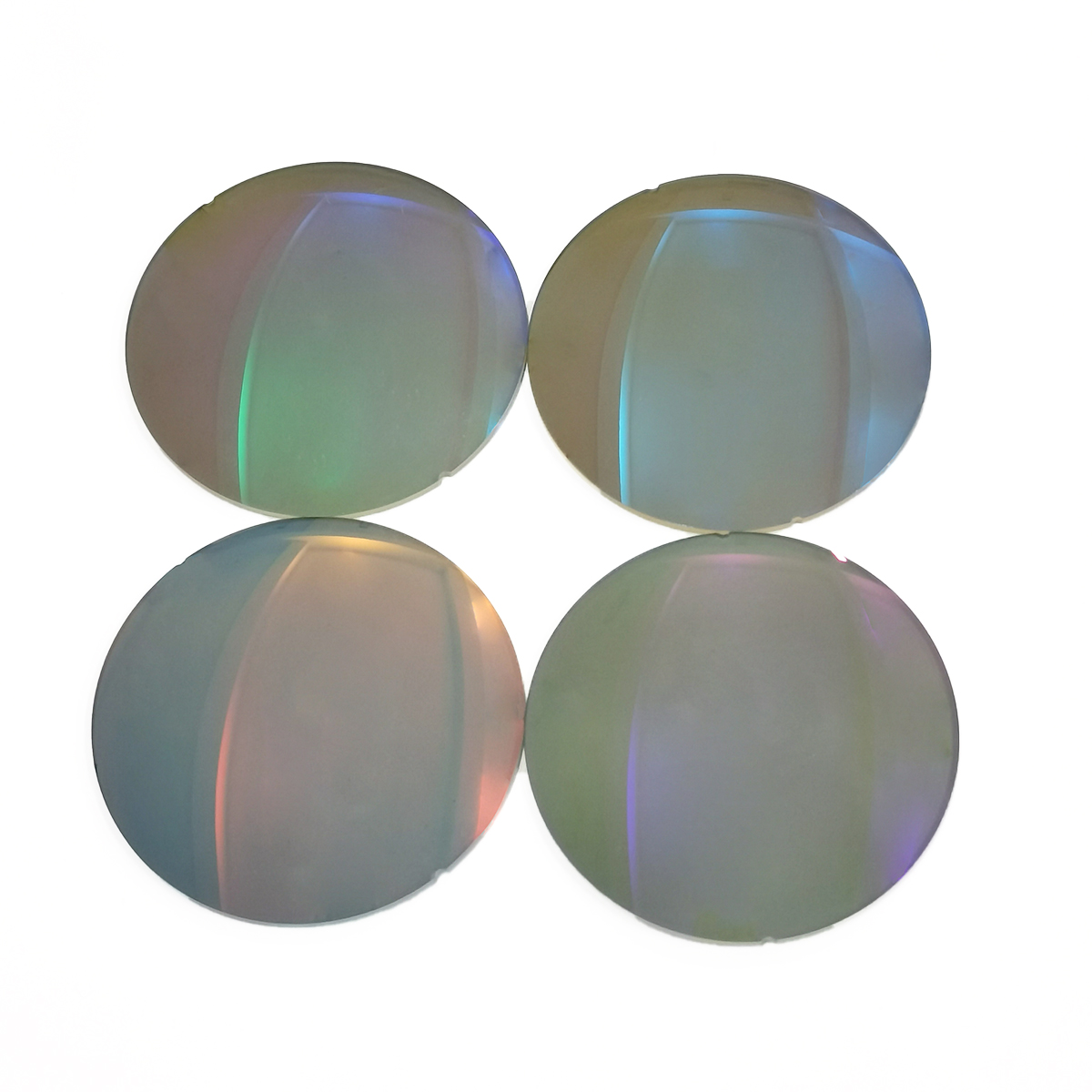 Impact-resistant PC coated sun lens Manufacturers, Custom Factory - Zhejiang QilQiliang Optical Technology Co., Ltd is China OEM/ODM Impact-resistant PC coated sun lens manufacturers and custom factory, Impact-resista...View Product →
Nylon lenses, often found in sports sunglasses and premium clip-ons, have a lower index than polycarbonate but higher light transmittance and lower distortion. They can feel more crisp when you are fishing or riding in changing light. The nylon lightweight anti-reflection polarized sun lens is a good example of this balance: it stays light, transmits more light, and keeps the field of view clean. For general wear, 1.60 and 1.67 offer the best thickness-to-cost ratio, while 1.74 should be reserved for prescriptions over about -6.00 or people who absolutely want the thinnest result.
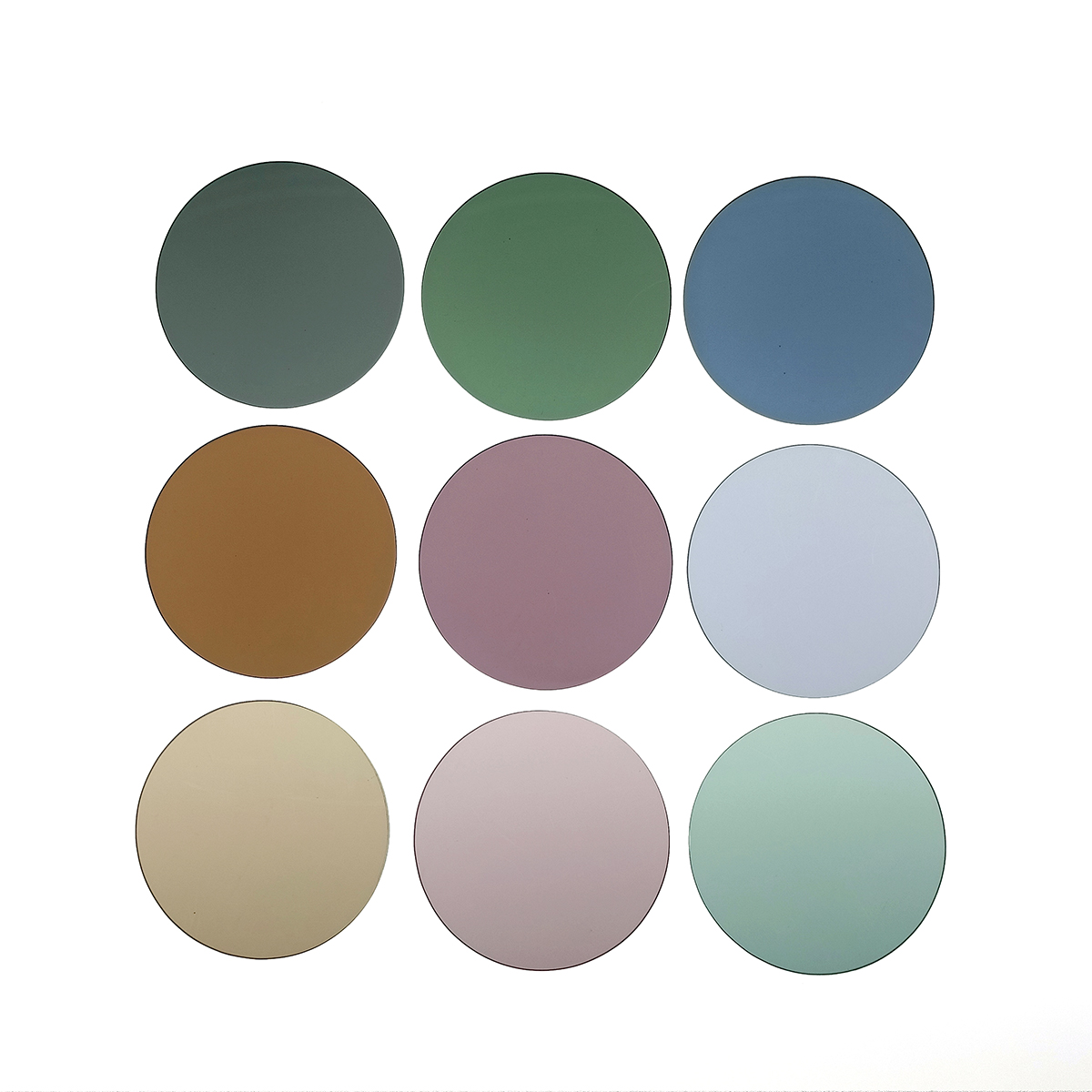 Nylon lightweight high transmittance anti-reflection polarized sun lens ManufactQiliang Optical Technology Co., Ltd is China OEM/ODM Nylon lightweight high transmittance anti-reflection polarized sun lens manufacturer...View Product →
Is a High-Index Lens Worth the Price?
High-index lenses are worth paying for only when they solve a visible problem: a thick edge, a heavy frame, or a cosmetic look you are unhappy with.
For prescriptions under +/-2.00, the visual difference between 1.50 and 1.67 is small, and the extra money is better spent on anti-reflective coating, photochromic tint, or a better fitting frame. For prescriptions at +/-4.00 and above, 1.67 or 1.74 will make the glasses feel lighter and look more balanced. The improvement in comfort can be significant for people who wear glasses all day.
Ask your optician to show you a lens thickness comparison for your exact prescription and frame. The calculation depends on the frame's lens diameter and your PD, so a generic recommendation from a website is not enough to know whether the upgrade is essential.
Frequently Asked Questions
What is a good lens index for glasses?
There is no single good lens index; for most low prescriptions, 1.50 or 1.57 is good, for moderate prescriptions 1.60 or 1.61 is a safe middle ground, and for high prescriptions 1.67 or 1.74 gives the best visible result.
Is a higher lens index always thinner?
Yes, for the same prescription and frame, a higher index produces a thinner lens, but the gain is not linear; moving from 1.50 to 1.60 is more noticeable than moving from 1.67 to 1.74.
Does lens index affect UV protection?
No. UV protection comes from the lens material and coatings, not from the refractive index; look for UV400 or 100% UVA/UVB protection when you choose your lenses.
Can high-index lenses be used in sunglasses?
Yes, sunglasses use the same lens index materials; polycarbonate at 1.59 is common in sports and safety sunglasses, while 1.60 and 1.67 are used when you want thinner edges in a fashion frame. For a full breakdown of tints, coatings and frame compatibility, see our guide to sunglasses and eye protection.
Does lens index matter for reading glasses and progressives?
Yes. Many reading prescriptions are plus powers, so high-index lenses reduce the thick center bulge and make progressives feel lighter and less distorted. If you are selecting reading glasses, step through the prescription, frame shape, and lens design together with our guide to reading glasses.
The Practical Takeaway
The practical takeaway is simple: choose the lowest lens index that still gives you the thickness and weight you find acceptable, then put your saved budget into a high-quality anti-reflective coating or a frame that fits well.
For most people, 1.60 or 1.61 is a reasonable default. If your prescription is below +/-2.00, you can save money with 1.50. If your prescription is above +/-4.00, 1.67 is a sensible upgrade, and 1.74 is worth considering for very high myopia or thin rimless designs. Let your prescription, frame size, and daily habits decide; the highest number is not always the best number.